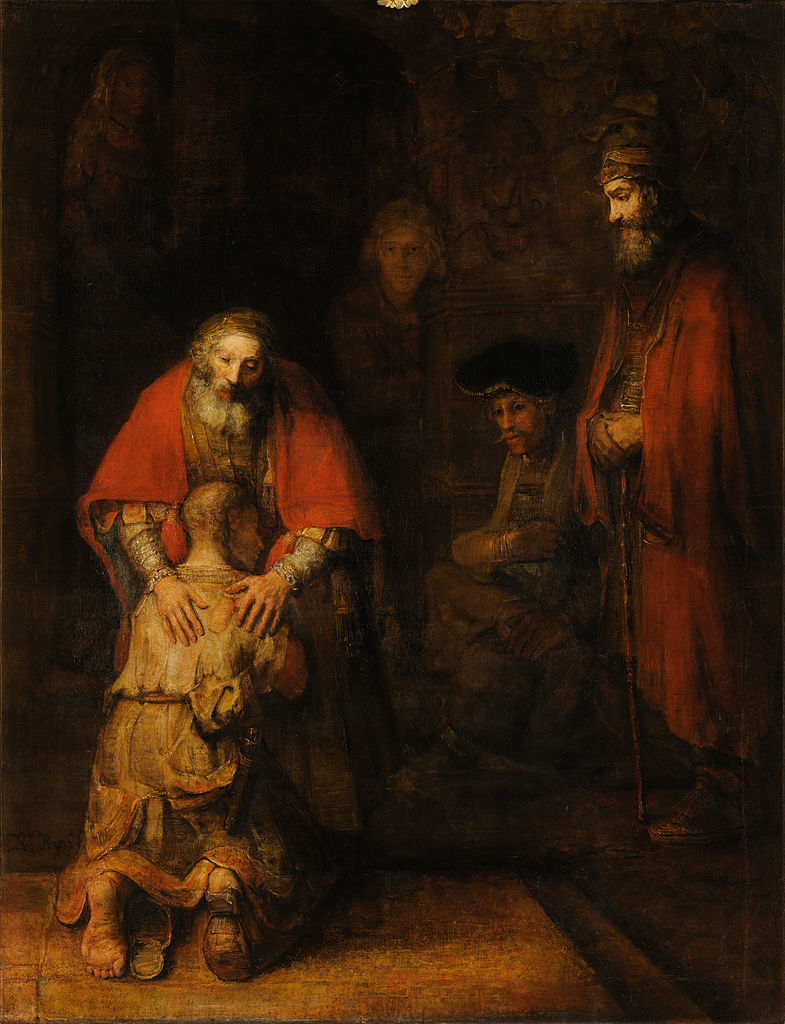
Sunday, May 1, 2016

Enemies

Epistle: Romans 5:6-11

New Testament: Luke 6:27-36

Sometimes, when I do the prayers of the people, there is a line that says, “Let us pray for enemies.” And I always thought of it as “let us pray on behalf of our enemies,” but Tommy Huggins shared with me that he hears it as “let us pray that we will get enemies.” I’ll let Tommy explain to you the logic behind such a prayer (and there is logic behind it, I assure you); however, with all that’s going on in the world, I hardly feel compelled to ask for more enemies. There are already people in my life that I struggle to love. 

Is that true for any of you? Can you think of people who rub you the wrong way? Someone who has wronged you, or taken advantage of you? A person who, when you think of him or her, you just feel that uncomfortable queasiness in the pit of your stomach.

That’s who I want you to be thinking of during this sermon.

I recently came across a story that helps illustrate Jesus’ call in our gospel lesson to “love your enemies” (however many of them you happen to have).

The story was written by a young man named Sean Graves. By way of introduction, he explains: “I have a younger brother, Seth, who is thirteen[, and] my parents work at Lockheed Martin … I like space, but I’m more into electronics. I love computers, anything technological. I’ve been into electronics since I was a kid, that and cooking. My mom’s a pretty good cook, but I’m not crazy about some of the stuff she comes up with, like leftovers, for example. When I cook, I always just make it up as I go along. I never follow recipes. I may look at a recipe, but I don’t measure. I just dump it all in. I go by the feel of it.”[1]

Sean was sixteen when he wrote this essay. A year earlier, he and two friends had gone outside after lunch at their high school and saw two boys coming toward them with guns. Sean was shot several times, and one bullet nicked his spine.

This was the first mass shooting I can remember, and it took place at Columbine High School on April 20, 1999. I remember coming home from school and seeing it on the news. Eric Harris and Dylan Klebold killed thirteen people and wounded more than 20 others before ending their own lives.
One of the people they wounded was Sean Graves.

“If I was to list what I physically can’t do now that I could do before,” he writes, “it would be a long list. But what I can do is get around. Learning to walk again is hard, because after the shooting, I was left with no strength in my legs. It was like being a newborn. The doctors immediately had me up in leg braces. I started off with zero skills and zero strength, but then I learned to crawl. I can crawl around the house a little bit now and go down stairs. The stairs are tricky. It takes a lot of strength, strength I didn’t know I had, but I’m getting there. My upper body isn’t affected. It’s basically just my legs. I do have sensation in them. I can pretty much make my legs do what I want them to do, but they’re weak. … I’m slowly, gradually getting my walking skills back.”[2]

Because Sean had to use a wheelchair, he found a lot of people staring at him, especially when he went back to school.

“I feel embarrassed to be stared at, and I feel put on the spot,” he says. “[But] then it occurs to me that this is what happened to Dylan and Eric. This is what everyone says drove them. … There is a way in which my experience now of going to school and having kids stare at me reminds me of the same kind of teasing and bullying that Dylan and Eric got and that drove them to such a place of anger and rage.”[3]

Sean doesn’t write much about his faith – he says that he prays, and that’s about it – so I don’t know if he’d ever heard the passage we read from Luke this morning, but what he says in the conclusion to his essay is a nearly perfect paraphrase of Jesus’ message about how we are to treat one another: “If I could change anything in the world,” Sean writes, “I’d stop people from hating each other. I’d make love the law of the land instead of hate. But I don’t know how to enforce that.”[4]

If Jesus knew how to enforce it, he didn’t explain it to us. The kind of love he describes is a choice each one of us has to make. When I say, “this is a difficult passage,” it is the understatement of the century. My seminary friend, Rachel, reads almost all my sermons before I preach them (and I read almost all of hers). The first line of her email in response to this one was: “Pray for your enemies? What a rotten concept.”

What Jesus teaches about enemies is so difficult, in fact, that commentators believe that this may be one of his most well-preserved sayings.[5] People generally simplify things as they pass them along – they smooth out the rough edges, making stories easier to remember and sayings easier to follow. 

“Love your enemies” is anything but easy – it is a rough, messy command that seems impossible to fulfill. And when he says “love your enemies,” he isn’t just talking about a warm feeling inside; he’s talking about seeking the good of those who have hurt us.

Again, Sean explains this love better than I can. He writes, “If Eric and Dylan were in the room right now and I could say anything to them, I’d say, ‘You need help,’ because they really did need help. If I could go back to any point in time, instead of going back to find them with a fully loaded gun and killing them, I’d go back to when they most needed help, and somehow get it to them. That way, no one is lost.”[6] 

That way, no one is lost. I’m speechless when I remember that this wisdom comes from a sixteen-year-old boy struggling to learn to walk again because of what was done to him.

We may ask, can’t we just forgive our enemies and forget about them? Why does Jesus call us to love them as well? The answer is both simple and impossible: we are to act this way because God acts this way.

“Be merciful, just as your Father is merciful.”

In Romans we read that the evidence of God’s love for us is that while we were still powerless, while we were still sinners, while we were still God’s enemies, Jesus died for us. Romans shows us that we are no longer God’s enemies; the paradox of Jesus’ message is that those who love their enemies no longer have enemies.[7] Truly overcoming enemies is not about destroying them, but about showing them unconditional love. Such a love restores them to wholeness and relationship – with the community and with God.

Jesus’ call to unfailing love is a difficult one to follow, but it is one he preached in words, in the way he lived his life, and especially in the way he died. In the story of his crucifixion, we see Jesus’ unfailing love for his disciples, for his persecutors, and ultimately, for us. His love is perfect; ours will fall far short of the mark. And when we do, we ask God’s forgiveness.

How do we even begin this task? The writer Frederick Buechner invites us to begin by taking a good look at our enemies, seeing the lines in their faces, he says, and the way they walk when they’re tired.
He invites us to see who their husbands and wives are – their brothers and sisters and parents. Maybe to see where they’re vulnerable. When we can see that, he says, we can see where they’re scarred. Seeing what is hateful about them, we may catch a glimpse of where the hatefulness comes from.

Seeing the hurt they cause us, he suggests, we may also see the hurt they cause themselves. We’ll still be light-years away from loving them, to be sure, but at least we’ll see how they are human even as we are human, and that is a step toward what Jesus calls us to do in the gospel lesson for today.
It’s possible we may even get to where we can pray for our enemies a little, if only that God might forgive them because we ourselves can’t do it yet. But any prayer we make is a breakthrough.[8]

This is what Sean was able to do with Dylan and Eric.

I think prayer is a good starting place in the process of learning to love our enemies. But maybe praying feels like too much, and the best we can do is try to say their names – to recognize that our enemies are people just like we are, that they need God’s love just like we do. Perhaps even saying their names is too much. Then I think we need a friend who will come alongside us and pray for our enemies for us – someone to shoulder the burden that is just too heavy right now.

That’s what communities like this one are for: helping each other carry burdens that are far too heavy for any of us alone.

Whatever the case may be, as we prepare to share the Lord’s Supper, let’s try to take one step toward reconciliation with those who have hurt us. Let’s work to overcome our enemies not with violence, but with love. Let’s follow the one who comes into the world again and again and again – the one who shows us that there is room at the table for everyone.

That way, no one is lost.

Amen.


[1] Sean Graves, Real Boys’ Voices, ed. William S. Pollack (New York: Random House, 2000) 182-187
[2] Graves, 183.
[3] Graves, 183.
[4] Graves, 187.
[5] Robert W. Funk, The Five Gospels (New York: HarperCollins, 1997) 147; Donald A Hagner, Matthew 1-13 (Dallas, TX: Word Books, 1993) 133.
[6] Graves. 185-7.
[7] Funk, 147.
[8] Frederick Buechner, Beyond Words (New York: HarperCollins, 2004) 95-96.

Monday, April 4, 2016

Recognizing

Scripture Lesson: Luke 24:13-35

Dear Norah,

This story, about Jesus appearing to his friends after he died, is not one I expect you to understand for a long time. In fact, I’m not entirely sure I understand it! It’s a very strange story, and it doesn’t really make sense. Why didn’t the disciples know it was Jesus when he was walking with them? Why did he pretend he didn’t know what had been going on? Why did he disappear at just the moment they recognized him?

There’s a book your Grammy gave you called I’d Know You Anywhere, My Love, and I couldn’t stop thinking about it as I read the most compelling moment of this story: the disciples recognizing Jesus as he broke the bread.

“There are things about you quite unlike any other,” the narrator of the story says, “things always known by your father or mother. So if you decide to be different one day, no worries… I’d know you anyway. If early one morning, you put on your socks and declare ‘For today, I’m a little red fox!’ I’d say, ‘My, my … that is quite a disguise!’ But I’d know it was you by the gleam in your eyes. …

“And if one fine day you got bored and you said, ‘Today I’m not me, I’m a lion instead.’ Even if I’d never heard it before, I’d know it was you by the sound of your roar.”[1]

There are moments in life when a person does something that reveals a facet of their character that is deep and true. Once we see that part of them, we’d know them anywhere. In some cases, because we are all made in the image of God, a person’s actions even help us recognize something about God’s character.

For example, on Maundy Thursday, Pope Francis got a lot of attention by washing peoples’ feet. This act of humility, in and of itself, would be enough to bewilder the world. After all, the world tells us that powerful people don’t do dirty work like washing feet. The ritual is something that previous popes had done – of course, it’s based on Jesus’ washing his disciples’ feet on the night of his last supper with them.

But Francis got even more attention because he changed things a bit this year. Instead of selecting a few Catholic men, as had been traditional, the people he chose were all refugees – but that was the only thing they had in common. Four of them were Catholics from Nigeria; three of them were Coptic Christians; three more were Muslims from Mali, Syria, and Pakistan; and one was a Hindu man from India. Two of them were women, one of whom had a baby that Francis also blessed.

The world was shocked that a Catholic Pope would stoop to wash the feet of people who practiced a different religion than he does. In the midst of a week when terrorist bombings were in the news; in the midst of the American election that has vilified Muslims and Mexicans, among others; in the midst of a news cycle filled with stories about laws that seek to dehumanize gay, lesbian, and transgender people; in the midst of all this, the Pope’s actions were incomprehensible to those who do not understand that power is truly found in humility, and that, in Frances’ words, “All of us together: Muslims, Hindus, Catholics, Copts, Evangelicals. … all brothers and children of the same God. We have different cultures and religions, but we are brothers and we want to live in peace.”[2]

The images of Pope Francis washing and kissing the refugees’feet are incredibly moving. They help us recognize something deep and true about his character – but more than that, they show us something of God’s character: inclusive, loving, humble, kind.

I experienced something like this the night you were born. It had been a long day. You weren’t supposed to come for almost another month, so I was at work in Richmond when your mom called me to say she’d gotten checked out at the doctor’s office and, sure enough, her water had broken.

“The baby is coming today,” she said, around nine in the morning. I couldn’t believe it! I rushed home, but it turned out I didn’t really need to because you waited until after midnight to be born.

All through the pregnancy, I knew I wanted to be in the room when you were born, but I also knew I wanted to be standing at the head of the bed, my hand resting on your mother’s shoulder, encouraging her, cheering her on – not seeing … anything. (I had seen a video of a woman giving birth in Health Class during high school and it was terrifying.) But after fifteen hours of waiting for you, I guess I wasn’t thinking clearly. When the nurse said, “Okay dad, you hold this leg, I’ll hold the other, and mom is going to push,” I just went with it.

As I looked into your mother’s face, I saw such strength, such determination, such courage. And it’s hard to explain, because these were all qualities I already knew she had. It’s not like I was learning that she was strong, determined, and courageous. It’s like I was recognizing these qualities, distilled to their very essence in her. And not only that, but I recognized the kind of courage it takes to create life, to suffer – meaningfully – as you bring it into the world, to risk your own comfort, your safety, your very existence. And I recognized: all these things are true about the ways God brings life into the world.

After several minutes of pushing, I watched as you were born. And because we didn’t know if you were a boy or a girl, the doctor asked, “Okay Josh, who is it?” And I said, “It’s- it’s- NORAH!” When I think about that moment, I can say I truly understand what the disciples meant when they asked, “Weren’t our hearts burning within us?”

He Qi: "Maundy Supper at Emmaus"
Their hearts were burning in that moment of recognition, when they saw him break the bread. It’s such a magical moment. In some ways, it seems literally magical, as if something unexplainable is going on. In other ways, it seems magical in the way your birth was magical – completely explainable, and miraculous all the same.

I imagine the disciples watching as Jesus’ hands took the bread and broke it. I imagine them, having just recited the story of his life back to him on that long walk to Emmaus, remembering the time be broke the bread to feed five thousand people; remembering the time he taught them to pray for daily bread; remembering the time he invited them all to the same table for one last meal, and broke bread, and said, “This is my body, broken for you.”

Jesus fed the disciples the whole time they were with him. He fed their bodies with bread, their minds with parables, and their spirits with his unconditional love. In those ways, he was the perfect embodiment of the ways God feeds us.

When he broke that bread, they recognized him because it was something they had seen him do dozens of times before. Whatever effect death and resurrection had on him, his ability to personify God’s feeding of us did not change.

And so they recognized him, and they recognized God. The psalmist says, “I believe I shall see the goodness of the Lord in the land of the living.” This story is the perfect example that we can see God at work in this world.

Whoever’s hands break the bread, we can see God present there.

Whoever’s body gives birth, we can see God present there.

Whoever’s lips kiss in blessing, we can see God present there.

I hope I can teach you to keep your eyes open and pay attention, to look for the Lord in the simplest moments and the most extraordinary. Because one day I hope you’ll be able to say to God, “I’d know you anywhere, my love!”

Amen.


[1] Nancy Tillman, I’d Know You Anywhere, My Love. New York: Feiwel & Friends, 2013.

Sunday, March 27, 2016

Go!

Living God, long ago, faithful women proclaimed that Jesus’ tomb was empty, and the world was forever changed. Help us to watch them. Help us to listen to them. Teach us to keep faith with them, that our witness may be as bold, our love as deep, and our faith as true.[1] Amen.

* * *

The scene is cinematic in its scope: It’s sunrise, first thing in the morning. A huge stone has been rolled away from the tomb’s entrance. Five or more women, charged with anointing the dead body of a man they loved, linger at the entrance, wondering what they’ll find inside. Then, a question:

“Why do you look for the living among the dead?” Perhaps after two thousand years of telling the story of Jesus’ death and resurrection, after hearing it over and over again, we might want to ask them the same thing. If we’re thinking of it as a movie, it’s like a movie we’ve watched dozens of times – we know more than the characters do, and we find ourselves yelling at the screen. 

“The poison’s in the other glass!” or “Don’t leave the deposit in the newspaper, Uncle Billy!” or just “Don’t go in there!” This morning, taking in this scene, maybe we want to yell at these women: “He’s alive! Don’t you get it?”

But they don’t. And of COURSE they don’t! Because these are the women who saw Jesus die. They saw him beaten and nailed to a cross; they watched, from a distance, as he was mocked; they saw him suffer, heard him say, “Father, into your hands I commit my spirit”; they watched as he breathed his last; they saw the tomb and how his body was laid in it. Of course they were looking for him among the dead – they saw him die.

But they saw other things as well.

Luke tells us that these women had been following Jesus since Galilee – that means they had been following him since the very beginning of his ministry, on a day perhaps three years before, when he stood up in the synagogue in Nazareth (his hometown) and read from the book of Isaiah:

“The Spirit of the Lord is upon me,” he said. “and has anointed me to proclaim good news to the poor, freedom for the prisoners, recovery of sight for the blind; to set the oppressed free; to proclaim the Lord’s favor!” The women saw how the crowd first adored him, then turned on him.

They watched as he moved from town to town, teaching wherever he went, spreading the news of God’s love in a way that changed people’s lives. And then, in a synagogue one day, they saw something terrifying: a man possessed by a demon, crying out, “Go away! What do you want with us, Jesus of Nazareth?” Jesus simply and sternly said, “Be quiet. Come out of him!” The demon obeyed, and the women were amazed.

They watched as he continued casting out demons, freeing people from all the things that tried to possess them. And then, he did something new. It started with a woman whose fever mysteriously went away after Jesus spoke to her; the skin of leprous people cleared up; those who were paralyzed stood and walked; a man born blind was able to see. 

Before long Jesus was inundated with the sick and disabled – people who had long ago believed they would never recover from their maladies – and he brought healing to all of them. The women were astonished at these events, these miracles, but more than that, they were shocked because, unlike every other healer they’d ever seen or heard about, Jesus did it for free.[2]

Along the way, these women saw Jesus take an interest in the lives of all kinds of people. One day, he stopped at a lakeside, inviting some poor fisherman named Peter, James, and John to follow him. Later, as he was passing by a tax booth, he invited a rich tax collector named Levi to join them. 

When people brought children to him, seeking a blessing, he didn’t send them away as his disciples assumed he might; instead he was giddy, saying, “The kingdom of heaven belongs to these ones! The Lord has hidden things from the wise and revealed them instead to little children.”

He spent time with the Pharisees – the religious elites of the day – and went to banquets at their homes. He also ate with people from all walks of life – Jews and Gentiles alike, and even people the Pharisees believed to be unworthy sinners.

As the women listened to Jesus’ sermons, they began to hear him teach more and more about loving their enemies: “Bless those who curse you,” he would say, “and pray for those who mistreat you. … Be merciful, just as your Father is merciful.” And Jesus didn’t just talk about these things – he did them! He healed a Roman Centurion’s son, even though the Romans were the Jews’ oppressors. He healed Samaritans and told stories in which they were the heroes, even though they practiced a different religion than the Jewish people.

He also talked about the Kingdom of God, which didn’t exactly sound like a particular place. He said it was like a mustard seed – an invasive weed that could take over a whole garden; or like yeast, just a little bit of which can leaven a whole ton of wheat. To the civil authorities, this sounded like code language for rebellion. To the religious authorities, it sounded like a threat to their power.

And that was when the women started to hear people plotting against him. There were whispers at first, and then the threats became bolder and more specific. As time went on, it was more and more obvious that, if Jesus were to set foot back in Jerusalem, he would be killed. His disciples tried to temper his rhetoric: “Why do you always say what you believe?” they asked. “Every proclamation guarantees free ammunition for your enemies!”[3] The problem was, he didn’t just say what he believed; he did what he believed. Despite the protests of those who loved him most, he continued his trek to the city that kills its prophets.

He wasn’t there a week before they arrested him. One of his closest friends betrayed him, everyone deserted him, and the authorities killed him.

And the women saw him die.

That’s why they were looking for him in the tomb that morning.

* * *

It seems odd to me that, of all the characters who appear in today’s scripture reading – the appointed reading for Easter this year – Jesus himself is not one of them. The women don’t find him in the tomb, and neither does Peter. Luke’s story of the first Easter morning does not include an appearance by the risen Christ.

So what does that mean?

It means we’ve got to go! We’ve got to get up and go and find him. We’ve got to stop looking for the living among the dead. Perhaps this seems like a daunting task – it’s hard to know where to begin. But the women in this story can help us, because they’ve followed him throughout his ministry. They’ve seen where he’s been. They know where he would go.

He cast out demons. We should look for Christ among those who are wrestling with drug addiction, credit card debt, self-harm, alcoholism, depression.

He healed the sick. We should look for Christ in the cold and flu aisle, in the ambulance screaming down the highway, in the operating room, in the ICU, in the rehab center, in the assisted living facility.

He welcomed children. We should look for Christ in classrooms and schoolyards and daycare centers; in orphanages and foster homes and juvenile detention centers; on the ball field and the ballet studio and the playground.

He ate with the poor and the rich. We should look for Christ at the fast-food drive-thru and the French restaurant and our own humble kitchen tables.

He embraced his enemies. We should look for Christ in the people we’d most like to avoid – at work, in our families, perhaps even in this very sanctuary; we should look for Christ in the political candidate we’d be least likely to vote for; we should look for Christ in suicide bomber.

He sought out the lost. We should look for Christ among the grief-stricken families in Brussels, the undocumented workers in our country, the prisoners in Guantanamo Bay, the refugees throughout the world.

This is what resurrection means: the Kingdom of God is not a place we discover after we die, but a place God is making, here and now, in this broken and hurting world. The empty tomb is a call to each one of us, to go! Go out into the world, seeking the risen Christ wherever he may be found, serving everyone we encounter along the way. 

So go! Go! He is risen! He is risen indeed! 

Amen.


[2] Reza Aslan, Zealot. New York: Random House, 2013. (103)
[3]Non-Stop” from the Hamilton soundtrack, Lin-Manuel Miranda, original Broadway cast of Hamilton.

Sunday, March 20, 2016

Stones Shall Shout

Our raucous parade is over;
hosannas waft into the cloudy sky.
Hush.
What do you hear?
The choir’s last suspended note.
Bird song.
Cars and semis rumbling down 29.
An Amtrak whistle.
March winds swishing pine needles.
A sluggish wasp in flight.
The constant buzz of tinnitus.
Put those sounds aside.
Listen.
The mountains, rocks, and stones
are cheering.

a poem for Palm/Passion Sunday 2016
by Rachel Horsley

Sunday, March 13, 2016

Mary Knows

"Mary and Martha" by He Qi
she shopped
for the spikenard oil
exchanged denarii
with the high-end herbalist

Mary knows

this perfume is for His burial
yet when Jesus arrives
at her brother's house
it is His life she anoints

Mary knows

the fragrance is strong
heady incense
she wipes the excess
from His feet with her hair

Mary doesn't know
in the violent days to come
she will seek solace
drawing scented tresses
about her face.

a poem for the fifth Sunday in Lent by Rachel Horsley
based on John 12:1-8

Monday, March 7, 2016

Hungry

New Testament: Luke 15:1-3, 11-32
“The Hunger Games” is series of books set far in the future, after the United States has collapsed and then been pulled back together by an oppressive, dictatorial leader. Every year, each of the twelve districts are forced to send two children to The Capital to fight to the death on national television. It’s a dark vision of human nature – one that highlights some of the most disturbing truths about the selfishness and desire for control that often define us.
But it’s also a story of hope, and as I was reflecting on the story of the Prodigal Son, his hunger reminded me of a crucial scene in the first book of the series. The main character, Katniss, is forced to grow up too early; she had to take responsibility for providing for her mother and younger sister after her father was killed.
There comes a point where Katniss has nothing for her family to eat – she even looks through the trash bins, discovering they’ve just been emptied.
“When I passed the baker’s,” she narrates, “the smell of fresh bread was so overwhelming I felt dizzy. The ovens were in the back, and a golden glow spilled out the open kitchen door. I stood mesmerized by the heat and the luscious scent until the rain interfered, running its icy fingers down my back, forcing me back to life.”
All of a sudden, the baker’s wife is yelling at Katniss, telling her to move on, shrieking that she’s sick of brats always coming around. The young girl notices a boy peering out from behind the screaming woman and recognizes him from school. She will come to learn that his name is Peeta, but at this point he is a complete stranger to her. Katniss moves along, trying to take some shelter under a tree that’s just beyond the baker’s pigsty.
“The realization that I’d have nothing to take home had finally sunk in,” she says. “My knees buckled and I slid down the tree trunk to its roots. It was too much. I was too sick and weak and tired, oh, so tired.
“There was a clatter in the bakery and I heard the woman screaming again … Feet sloshed toward me through the mud. … It was the boy. In his arms, he carried two large loaves of bread that must have fallen into the fire because the crusts were scorched black.
“His mother was yelling, ‘Feed it to the pig, you stupid creature! Why not? No one … will buy burned bread!’
“He began to tear off chunks from the burned parts and toss them into the trough … [He] took one look back to the bakery as if checking that the coast was clear, then, his attention back on the pig, he threw a loaf of bread in my direction. The second [loaf] quickly followed, and he sloshed back to the bakery, closing the kitchen door tightly behind him.
“By the time I reached home, the loaves had cooled somewhat, but the insides were still warm. When I dropped them on the table, [my sister’s] hands reached to tear off a chunk, but I made her sit, forced my mother to join us at the table, and poured warm tea. … We ate an entire loaf, slice by slice. It was good, hearty bread, filled with raisins and nuts.”[1]
This story reminds me of the situation in which many of us – perhaps all of us – find ourselves, at one time or another. I expect that everyone here has food enough to keep them from the kind of physical hunger that Katniss and the Prodigal Son experienced. But scripture tells us that people don’t live by bread alone. That’s something that Jesus knew very well. He quoted that passage of scripture when he was fasting in the wilderness and Satan tried to tempt him into turning stones into bread that he could eat. There are so many things for which we hunger.
I believe there is food out there, and sustenance for a starving world. People don’t live on bread alone. Physical exercise keeps our bodies strong and active. Our minds are nourished as we engage in critical thinking and test what we believe.
Positive, encouraging relationships help us to grow in our sense of who we are and what we can accomplish. Spiritual practices like prayer, confession, meditation, reading scripture, and gathering for worship nourish our connection with God and the people around us. We have to pay attention to each of these aspects of our lives, making sure that we receive the sustenance we need for each of them.
We don’t just live by bread alone.
Often, we are hungry for something else. Jesus understood how people can spiritually starve to death, and I think that’s why he decided that the last thing he’d do with his disciples was share a meal with them. He gathered them all together to eat the Passover meal – but he changed things a little. As he gave out the bread, he said, “This is my body.” And he blessed it and broke it. He told them that, every time they ate bread, they should remember God and remember how God feeds people. Not just our bodies, but our spirits as well.
If we look at Katniss’ experience, it may be more similar to ours than we’d like to admit.
First, she tried to feed herself – and we try to do that, too. We try to solve our own problems and tell ourselves that we’re strong enough or smart enough to get through life all on our own. That didn’t work for Katniss, and it doesn’t work for us. Next, she looked in the trash, and we do that sometimes. We look for our spiritual food in the wrong places – in destructive relationships, in drugs and alcohol, in the latest technology or the most prestigious job or whatever it is that the world tells us should satisfy our deep, insatiable longing. But those things are fleeting, and while they might make us feel better for a minute or a day or even a week, they don’t last. Soon enough that hunger returns.
Finally, Katniss gave up. She laid down with hunger gnawing at her stomach, and that was when the bread finally came. Unearned. Undeserved. From an unexpected source – a stranger who would one day become an ally, perhaps even a friend. And that bread wasn’t trash, it wasn’t stale or dry – “It was good hearty bread, filled with
raisins and nuts.”
Friends, that is the kind of spiritual bread that Christ offers to us: bread that is fulfilling and nourishing, bread that awakens our spirits, even when we feel trapped in the cold and the rain, even when we feel like we might be dead inside. The task for us is admit that we’re hungry, and to look to the one who is willing to risk a beating for us – who is willing to take on death itself – to provide the food and connection that we so desperately need.
For what do you hunger today? Love? Justice? Hope? Courage? Forgiveness? Companionship? Connection? Christ offers us all these things and more at his table. Sometimes his table looks like the table at the front of our sanctuary; and sometimes it looks like the table where a father and his two sons share a fatted calf; and sometimes it looks like the table where a daughter, mother, and sister share a loaf of hearty bread; and sometimes it just looks like your own kitchen table, battered and banged up over the years. Native American poet Joy Harjo writes beautifully about the metaphor of a table:
The world begins at a kitchen table, she writes. No matter what, we must eat to live. The gifts of earth are brought and prepared, set on the table. So it has been since creation, and it will go on.
We chase chickens or dogs away from it. Babies teethe at the corners. They scrape their knees under it.
It is here that children are given instructions on what it means to be human. We make men at it, we make women.
At this table we gossip, recall enemies and the ghosts of lovers.
Our dreams drink coffee with us as they put their arms around our children. They laugh with us at our poor falling-down selves and as we put ourselves back together once again at the table.
This table has been a house in the rain, an umbrella in the sun.
Wars have begun and ended at this table. It is a place to hide in the shadow of terror. A place to celebrate the terrible victory.
We have given birth on this table, and have prepared our parents for burial here.
At this table we sing with joy, with sorrow. We pray of suffering and remorse. We give thanks.
Perhaps the world will end at the kitchen table, while we are laughing and crying, eating of the last sweet bite.[2]
So come: you who have much faith and you who have little,
you who have been here often,
and you who have not been for a long time,
you who have tried to follow and you who have failed.
Come, not because I invite you: it is the Lord,
and it is God’s will that those who desire life should meet God here,[3]
in good, hearty bread – to the last sweet bite.


[1] Suzanne Collins, The Hunger Games. New York: Scholastic Press, 2008, p.31
[2] "Perhaps the World Ends Here" from The Woman Who Fell From the Sky by Joy Harjo. Copyright © 1994 by Joy Harjo. 
[3] From the Iona community

Sunday, March 6, 2016

The Prodigal

It's a transparent story:
world-weary son,
driven by hunger,
back to his father's farm —
reduced to barefoot begging,
praying for menial work.

From a distance,
the father recognizes
something in the walk,
the posture,
the son he assumed
died dissolutely,
trudging toward him.

It only takes a second
to forgive.

Then the gifts:
the best robe, a ring,
sandals for his callused feet,
the roasting of a calf,
a party.

The thing is: we're all invited.
Let's put on our robes of love,
slip rings of faith on our fingers,
tie on our working/ dancing shoes,
feast at the table of spiritual cuisine;
let's rejoice!

a poem for the fourth Sunday in Lent, 2016.
by Rachel Horsley